Excerpt from Seymour An Introduction – J.D. Salinger

A good many years later, not long after the outbreak of the Second World War, when Seymour and I had just recently moved into a small New York apartment of our own, our father—Les, as he’ll be called hereafter—dropped in on us one evening on his way home from a pinochle game. He quite apparently had held very bad cards all afternoon. He came in, at any rate, rigidly predisposed to keep his overcoat on. He sat. He scowled at the furnishings. He turned my hand over to check for cigarette-tar stains on my fingers, then asked Seymour how many cigarettes he smoked a day. He thought he found a fly in his highball.

At length, when the conversation—in my view, at least—was going straight to hell, he got up abruptly and went over to look at a photograph of himself and Bessie that had been newly tacked up on the wall. He glowered at it for a full minute, or more, then turned around, with a brusqueness no one in the family would have found unusual, and asked Seymour if he remembered the time Joe Jackson had given him, Seymour, a ride on the handle bars of his bicycle, all over the stage, around and around. Seymour, sitting in an old corduroy armchair across the room, a cigarette going, wearing a blue shirt, gray slacks, moccasins with the counters broken down, a shaving cut on the side of his face that I could see, replied gravely and at once, and in the special way he always answered questions from Les—as if they were the questions, above all others, he preferred to be asked in his life. He said he wasn’t sure he had ever got off Joe Jackson’s beautiful bicycle. And aside from its enormous sentimental value to my father personally, this answer, in a great many ways, was true, true, true.

Excerpt from Looking for Alaska – John Green

Imagining the future is a kind of nostalgia. You spend your whole life stuck in the labyrinth, thinking about how you’ll escape it one day, and how awesome it will be, and imagining the future keeps you going, but you never do it. You just use the future to escape the present.

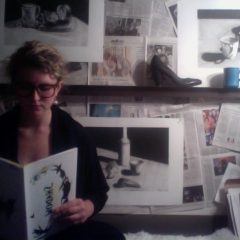
Question Sunday – Can Poetry Be a Visual Medium?

sheepwithasword:

sheepwithasword:

Bit of a continuation of last week’s question:

Can poetry be a visual medium? Is it always a visual medium, never a visual medium, or sometimes a visual medium?

My answer: It is a visual medium as long as it is being read on the page. The way words look will always…

Got this response in my ask box from one of my first followers (and one of the first I followed), snake-oil-lullaby. I thought it was a great response, and I learned some things, so I’m sharing it!

“In response to the Sunday question, I think poetry can be extremely visual. There’s three examples I can use from my background as a U.S. Marine, a graphic designer, and a newspaper editor.

1: In many Islamic countries, iconography is forbidden. To get around this, they will use Arabic Calligraphy to make art. Some of the most beautiful verses of the Quran are made far more poetic by the flowing strokes of a master calligraphist.

2: Typography is the arrangement of the letters on the page.  The fonts used and even the spaces between individual letters (tracking and kerning) can give a message more meaning and stress or enforce certain words. A prime example would be Tristen Tzara’s use of typesetting in his Dadaist Manifestos.

3: They’ve done studies on the size of type in newspaper print to determine the impact it has on the reader’s comprehension and how they react to certain variations (and even if their moods can be changed by the font and weight selected.)  I was gonna get more into that, but I didn’t.

So I would say that, yes. Poetry is a very visual medium, but like any art it goes beyond that, and channels something that we can’t really see.

Sorry if that was a bit lengthy, but that’s what I think.”

Question Sunday

Excerpt from To Kill A Mockingbird – Harper Lee

One more thing, gentlemen, before I quit. Thomas Jefferson once said that all men are created equal, a phrase that the Yankees and the distaff side of the Executive branch in Washington are fond of hurling at us. There is a tendency in this year of grace, 1935, for certain people to use this phrase out of context, to satisfy all conditions. The most ridiculous example I can think of is that the people who run public education promote the stupid and idle along with the industrious—because all men are created equal, educators will gravely tell you, the children left behind suffer terrible feelings of inferiority. We know all men are not created equal in the sense some people would have us believe—some people are smarter than others, some people have more opportunity because they’re born with it, some men make more money than others, some ladies make better cakes than others—some people are born gifted beyond the normal scope of most men.

But there is one way in this country in which all men are created equal—there is one human institution that makes a pauper the equal of a Rockefeller, the stupid man the equal of an Einstein, and the ignorant man the equal of any college president. That institution, gentlemen, is a court. It can be the Supreme Court of the United States or the humblest J.P. court in the land, or this honorable court which you serve. Our courts have their faults, as does any human institution, but in this country our courts are the great levelers, and in our courts all men are created equal.

I’m no idealist to believe firmly in the integrity of our courts and in the jury system—that is no ideal to me, it is a living, working reality. Gentlemen, a court is no better than each man of you sitting before me on this jury. A court is only as sound as its jury, and a jury is only as sound as the men who make it up. I am confident that you gentlemen will review without passion the evidence you have heard, come to a decision, and restore this defendant to his family. In the name of God, do your duty.

—-Atticus Finch

I wrote a book. It sucked. I wrote nine more books. They sucked too. Meanwhile, I read every single thing I could find on publishing and writing, went to conferences, joined professional organizations, hooked up with fellow writers in critique groups, and didn’t give up. Then I wrote one more book.

Beth Revis (via writingquotes)