I’m wary of saying that writers have an obligation to do anything in particular — most often, you’ll find someone who doesn’t do whatever thing so beautifully that they redeem its absence — but it’s hard to imagine an essay that would be satisfying without complexity, and it’s hard to imagine complexity without some version of what we’re calling problematizing: the negative capability of holding multiple possibilities at once.
Category Archives: Commentary
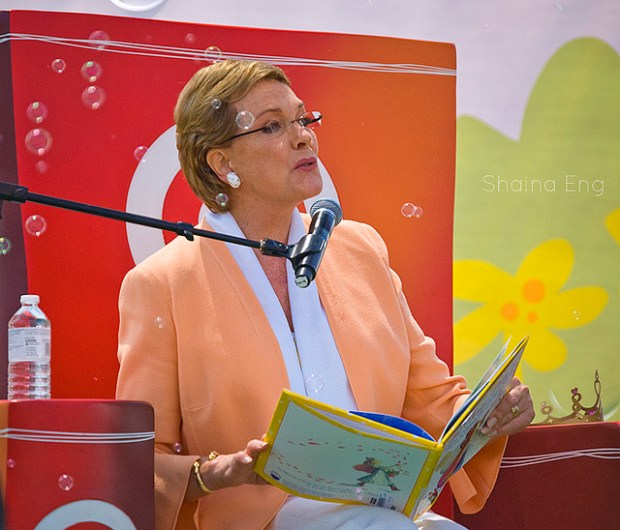
Julie Andrews – Classic Lit Queen

DSC_0007 by Shaina Kristi on Flickr.
Dame Julie Andrews
Could she be even more magical? Reading books for kids at LA Festival of Books
A Fluent Sentence on Fluency
Language that flows with rhythm and grace, logic and music. Sentences are well-crafted and want to be read aloud.
Question Sunday – Can Poetry Be a Visual Medium?
Bit of a continuation of last week’s question:
Can poetry be a visual medium? Is it always a visual medium, never a visual medium, or sometimes a visual medium?
My answer: It is a visual medium as long as it is being read on the page. The way words look will always…
Got this response in my ask box from one of my first followers (and one of the first I followed), snake-oil-lullaby. I thought it was a great response, and I learned some things, so I’m sharing it!
“In response to the Sunday question, I think poetry can be extremely visual. There’s three examples I can use from my background as a U.S. Marine, a graphic designer, and a newspaper editor.
1: In many Islamic countries, iconography is forbidden. To get around this, they will use Arabic Calligraphy to make art. Some of the most beautiful verses of the Quran are made far more poetic by the flowing strokes of a master calligraphist.
2: Typography is the arrangement of the letters on the page. The fonts used and even the spaces between individual letters (tracking and kerning) can give a message more meaning and stress or enforce certain words. A prime example would be Tristen Tzara’s use of typesetting in his Dadaist Manifestos.
3: They’ve done studies on the size of type in newspaper print to determine the impact it has on the reader’s comprehension and how they react to certain variations (and even if their moods can be changed by the font and weight selected.) I was gonna get more into that, but I didn’t.
So I would say that, yes. Poetry is a very visual medium, but like any art it goes beyond that, and channels something that we can’t really see.
Sorry if that was a bit lengthy, but that’s what I think.”
Poet-to-Poet – National Poetry Month 2014

For National Poetry Month 2014, we introduce Poet-to-Poet, a multimedia educational project that invites young students in grades 3-12 to write poems in response to those shared by award-winning poets who serve on the Academy of American Poets Board of Chancellors.
STUDENTS: To participate, watch the videos then write your own response poem. (Follow the directions on the site.)
TEACHERS: If you are interested in using Poet-to-Poet in the classroom, we worked with a curriculum specialist to design a series of activities, aligned with the Common Core, especially for you. Click the link to the Lesson Plans.
Excerpt from Men We Reaped – Jesmyn Ward
From 2000 to 2004, five Black young men I grew up with died, all violently, seemingly unrelated deaths…That’s a brutal list, in its immediacy and it’s relentlessness, and it’s a list that silences people. It silenced me for a long time. To say this is difficult is understatement; telling this story is the hardest thing I’ve ever done. But my ghosts were once people, and I cannot forget that.
Men We Reaped: A Memoir by Jesmyn Ward, 2013
After Suicide- Poets.org – Poetry, Poems, Bios & More
Big congrats to Matt Rasmussen, whose book, Black Aperture (winner of our 2012 Walt Whitman First-Book Award), was named a National Book Award finalist! Click here to listen to Rasmussen reading “After Suicide.”
A new novel takes vengeance on Google, Facebook
The Circle, by Dave Eggers, carries the potential to change how the world views its addicted, compliant thrall to all things digital.
Books Are Flourishing – Tess Keegan
It’s hard to say whether it’s more charming or disturbing that the most rebellious thing someone my age can do is read a book. And I do not mean a chemistry textbook. I mean the ones that force you to remember nuance, the relativity of perspective, and the gorgeous way words can illuminate the truth and still sound like poetry in that secret, fiendish way of all great works.
Above all, books tether us to all the people, struggles, spirit and imagination that came before us…
Books serve as the greatest lessons that insistent perseverance toward a better day, a better self, a better society, a better world will not go overlooked. We are merely links in a very very long chain that is still trying to wrest itself from all the kinks. It has always been about the vast, inventive ways to inflict suffering inward and outward, and those courageous enough have resisted this status quo and refused to accept necessity or inevitably as a valid cause.
Books are resilience. Books are flourishing. Books are about relishing novelty and the enormous array of ideas the human mind has gleaned. Books give us the confidence to savor the bittersweet mystery of the future ablaze with chance and choice. Books…are hot.
The Last Bookstore
“There is a place. Like no place on Earth. A land full of wonder, mystery, and danger!”
The Last Bookstore
Los Angeles, California(via eversolightly)