Death Day – A Tribute to Allen Ginsberg

Celebrating the life of Allen Ginsberg – Easter Sunday

On April 5, 1997, Allen Ginsberg, esteemed American poet who spanned influence over multiple generations, died from a combination of liver cancer and hepatitis. At the eve of his death, close friends, family and old lovers spent the night with him at his apartment in the East Village in New York City. Once he passed, Buddhist chants filled the air for hours until his they believed his spirit fully left his body.

5147
Allen Ginsberg, a true activist, mentor and poet.

“Poetry is the one place where people can speak their original human mind. It is the outlet for people to say in public what is known in private.” – Ginsberg

Allen Ginsberg was paramount to the Beat movement as a voice against militarism and political oppression. He was part of the counterculture publicly speaking out for the sexually and politically oppressed.

He is most known for exercising his freedom of speech in his poem “Howl” that spoke on homosexual relationships and the times of the American generation.

He studied at Colombia University where he made friends that shared his “new vision” and embarked on the epic journey of the poetic, beatific, buddhist life that still influences generations of artists today.

Favorite Quotes:

“I really believe, or want to believe, really I am nuts, otherwise I’ll never be sane.”

“Follow your inner moonlight; don’t hide the madness.”

Incomplete list of suggested reading:

  • Howl & Other Poems (1956)
  • Empty Mirror: Early Poems (1961)
  • The Yage Letters (1963)
  • The Fall of America: Poems of These States (1973)*
  • Illuminated Poems (1996)

*National Book Award for Poetry Winner

gins
“America I’m putting my queer shoulder to the wheel.” – Ginsberg

Interesting Fact:

Ginsberg and Anne Waldman helped found the Jack Kerouac School of Disembodied Poetics at Naropa University in Boulder, Colorado, which was started by Ginsberg’s biggest spiritual mentor, Chogyam Trungpa Rinpoche.
 

“A Day” – Emily Dickinson

I’ll tell you how the sun rose, —
A ribbon at a time.
The steeples swam in amethyst,
The news like squirrels ran.

The hills untied their bonnets,
The bobolinks begun.
Then I said softly to myself,
“That must have been the sun!”

* * *

But how he set, I know not.
There seemed a purple stile
Which little yellow boys and girls
Were climbing all the while

Till when they reached the other side,
A dominie in gray
Put gently up the evening bars,
And led the flock away.

Dave Eggers Said

“I have no idea how people function without near-constant internal chaos. I’d lose my mind.”

(A Heartbreaking Work of Staggering Genius)

“III. The Village” – David St. John

There are so many pianos still left


In the fields of the village

Where you insist that we continue


To live, so many pianos


Though only a few have remained faithful

To the serious chords of the wind.


For example, the camel-colored Steinway


Beneath the arbor of lavender wisteria

& drooping bougainvillea has barely


A dozen keys left working, their thin felt


Hammers long grown soggy as dawn mist,

Soft as the pillowing fog.


Still, you say, who cares? as you turn from me,


Stepping calmly onto the narrow stone terrace

Overlooking these perpetual fields—


Just as every young woman in this


Village stands each morning, every one of them,

& exactly at this moment of the day, satisfied by


The first ripple of light as it sketches


The body’s languid harmony. If I am lucky, I know

I will live forever in this ancient, lost village


Of pianos & a late pagan petulance.

– from The Red Leaves of Night

“The Mountain” – Emily Dickinson

The mountain sat upon the plain
In his eternal chair,
His observation omnifold,
His inquest everywhere.

The seasons prayed around his knees,
Like children ’round a Sire:
Grandfather of the days is he,
Of dawn the ancestor.

Death Day – A Tribute to John Steinbeck

Celebrating the Life of John Steinbeck

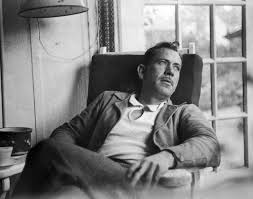
On December 20, 1968 John Steinbeck passed away from heart disease in his humble abode located in New York City. Steinbeck was best known for his literature on California, the working class and the land that ruled them. He was a Stanford student without ever completing his degree. He worked, wrote, and inspired American writers for ages to come.

steinbeck

I have come to believe that a great teacher is a great artist and that there are as few as there are any other great artists. Teaching might even be the greatest of the arts since the medium is the human mind and spirit. – Steinbeck

Favorite Quotes: 

“In utter loneliness a writer tries to explain the inexplicable.”

“The writer must believe that what he is doing is the most important thing in the world. And he must hold to this illusion even when he knows it is not true.”

Incomplete List of Suggested Reading:

  • Cup of Gold (1929)
  • The Pastures of Heaven (1932)
  • To a God Unknown (1933)
  • Tortilla Flat (1935)
  • In Dubious Battle (1936)
  • Of Mice and Men (1937)
  • The Long Valley (1938)
  • The Grapes of Wrath (1939)*
  • Sea of Cortez (1941)
  • The Moon Is Down (1942)
  • Cannery Row (1945)
  • The Pearl (1947)
  • Burning Bright (1950)
  • East of Eden (1952)
  • The Winter of Our Discontent (1961)
  • Travels with Charley: In Search of America (1962)**
*Pulitzer Prize Winner
**Nobel Prize for Literature

Interesting Fact:

Steinbeck visited Vietnam in 1967 to report on the war where he spent a night on watch for his two sons and the platoon to sleep.

TBT – New York Times, Nov. 17, 1924

Crossword Puzzles

A FAMILIAR FORM OF MADNESS: Latest of the problems presented for solution by psychologists interested in the mental peculiarities of mobs and crowds . . . is created by what is well called the craze over crossword puzzles. Scarcely recovered from the form of temporary madness that made so many people pay enormous prices for mah jong sets, about the same persons are now committing the same sinful waste in the utterly futile finding of words the letters of which will fit into a prearranged pattern, more or less complex. This is not a game at all, and it hardly can be called a sport; it is merely a new utilization of leisure by those for whom it would otherwise be empty and tedious.

(The New York Times inaugurated a puzzle page February 15, 1942 – just 18 years later.)